

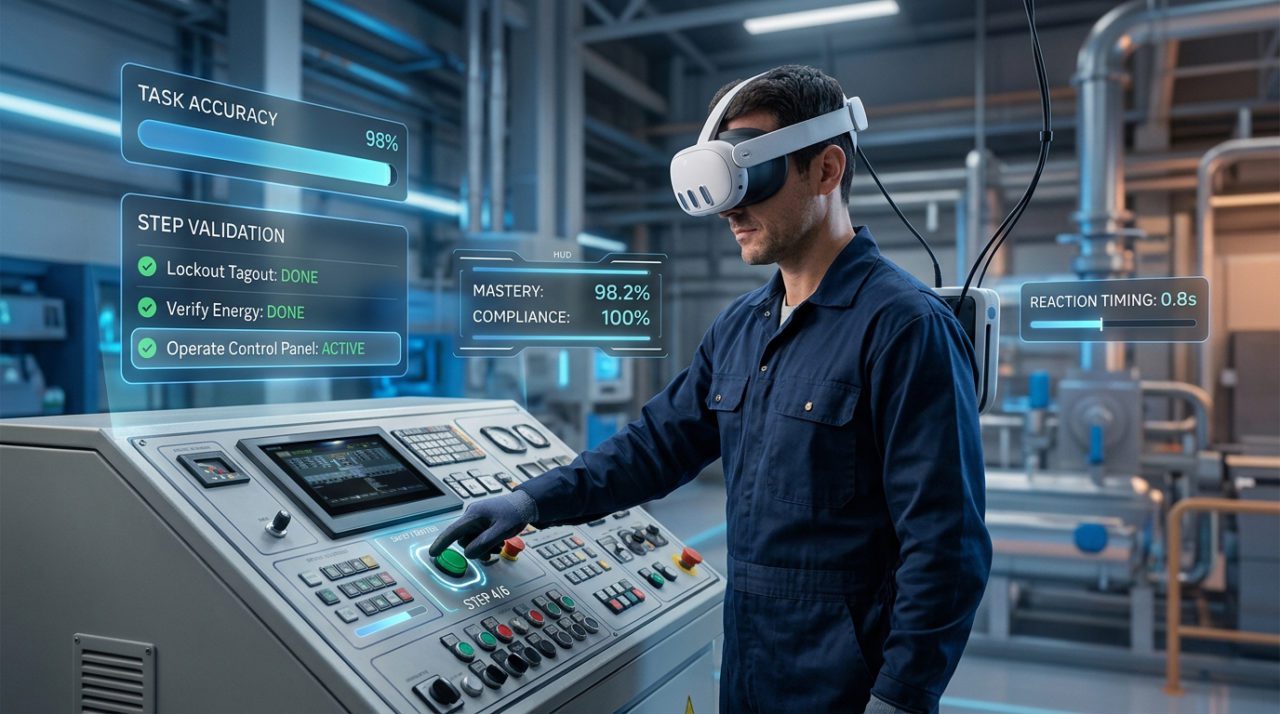
Digital Transformation in Action: VR & XR Training as the Future of Compliance and Safety
Digital transformation is a hollow shell if it stops at your server rack. For enterprises in high-stakes sectors, the ultimate “legacy system” is a workforce trained on static manuals and “click-through” e-learning. In an era of tightening EU regulations and shrinking margins, “participation” is no longer a proxy for “competence.” If your team cannot prove they can execute a high-voltage lockout or manage a biohazard containment under physical stress, your digital strategy has a single, massive point of failure: the human element. At [Agency Name], we deliver Human Telemetry Engines that turn workforce readiness into a measurable, bankable, and audit-ready corporate asset.
Key Takeaways
- DX Integration: VR and XR is not a silo; it is the visualization layer of your digital transformation strategy.
- Measurable Mastery: Transition from “attendance tracking” to granular competency heatmaps that predict field performance.
- Radical Standardization: Eliminate “local interpretations” of safety protocols with a single, unalterable digital source of truth.
- Audit-Automation: Replace manual logs with real-time performance metrics synced directly to your ERP/LMS.
- Risk Mitigation: Build muscle memory in zero-risk environments to eliminate “Low-Frequency, High-Consequence” events.
The Sector-Specific Transformation Matrix
We don’t provide “simulations.” We provide high-fidelity operational tools designed to align with the specific regulatory and physical demands of your industry:
| Industry Sector | The Critical Transformation Pain Point | VR & XR Strategic Solution | EU Regulatory Alignment |
| Manufacturing & Heavy Industry | Procedural drift in LOTO & maintenance | Digital Twin rehearsal for complex machinery | Machinery Directive 2006/42/EC |
| Construction | Site-specific hazard identification | 4D BIM-integrated environment | Directive 92/57/EEC |
| Logistics & Warehousing | Human-Machine (AGV) intersection risks | Spatial awareness & “Near-Miss” telemetry | ISO 45001 / ADR |
| Energy & Utilities | Grid resilience & high-voltage safety | Crisis response drills for catastrophic failure | NIS2 / EU Energy Directives |
| Oil & Gas / Process Industry | Fatal “Low-Frequency” event prevention | Multi-user emergency shutdown coordination | SEVESO III Directive |
| Rail & Transportation | Rolling stock downtime for training | Cab-signal & track-side hazard simulations | EU Rail Safety Directive |
| Healthcare & Emergency Services | SOP deviation in sterile/crisis zones | Haptic-enabled clinical/triage simulations | EU MDR / Annex 1 |
Beyond the Headset: The XR Digital Maturity Model
To lead your industry, you must move beyond “pilot projects.” True digital transformation via XR follows a four-stage evolution:
- Stage 1: Visualization (The Pilot): Replacing 2D manuals and PowerPoint decks with 3D immersive modules. This stage focuses on engagement and basic knowledge transfer.
- Stage 2: Validation (The Audit): Using VR data to prove competence to regulators. At this stage, the headset becomes a forensic tool for verifying that an employee is “audit-ready.”
- Stage 3: Integration (The Infrastructure): Linking XR performance data directly into SAP, Oracle, or your LMS. Training is no longer a silo; it drives real-time workforce scheduling and site access.
- Stage 4: Optimization (The Predictive): Leveraging “Human Telemetry” to predict where accidents are likely to occur. By analyzing error patterns across global sites, leadership can deploy targeted remediation before an incident happens.
Why Enterprise XR is the Only Way to Audit-Proof Your Operation
The modern regulatory landscape no longer accepts “I didn’t know” as a defense. As EU mandates tighten, the “Check-Box” approach to training has become a significant liability. Traditional training creates a Competency Gap—a dangerous void between what an employee knows on paper and what they can actually do when a turbine fails or a chemical seal breaks.
VR and XR solutions bridge this gap by providing Verifiable Evidence of Mastery. When a regulator or insurance auditor asks for proof of “effective training,” a sign-in sheet is meaningless. However, an XR data log showing 100% procedural accuracy during a simulated high-stress crisis is ironclad. Furthermore, these platforms enforce Radical Standardization. In global operations, shift leads often develop “local workarounds” that deviate from safety protocols. In an XR environment, the protocol is baked into the code; there is no “local version” of safety, only the corporate gold standard.
The Business Case: Tangible ROI for the C-Suite
The decision to implement Enterprise XR isn’t just about safety; it’s a strategic play for operational efficiency and fiscal responsibility. When you digitize workforce capability, the return on investment manifests in three primary pillars:
- Reduced Time-to-Competence: We have seen organizations reduce onboarding time by up to 40%. By utilizing high-fidelity simulations, new hires reach “expert” status without tying up expensive machinery or shadowing senior staff for weeks.
- Mitigation of Non-Compliance Costs: The financial fallout of a single regulatory fine or a workplace fatality can be catastrophic. Proactive XR training provides a “Digital Audit Trail” that protects the organization from litigation, insurance premium spikes, and the massive brand damage associated with safety failures.
- Predictive Workforce Planning: By integrating XR metrics into your ERP stack, HR and Ops leads can make data-backed decisions. If the data shows a specific team is struggling with a new LOTO procedure, you can intervene with targeted training before that weakness results in downtime or injury.
Conclusion: Stop Guessing, Start Measuring
Digital transformation is fundamentally about making the unpredictable predictable. If you cannot quantify the competence of your workforce, your safety program is a “black box” of potential failure. Immersive VR and XR training turns regulatory compliance from a burdensome administrative task into a strategic, data-driven competitive advantage.
The future of high-risk operations isn’t just digital—it’s immersive. Talk to an expert now
Frequently Asked Questions
Q: How does VR & XR training fit into a broader digital transformation (DX) strategy?
A: VR and XR function as the “Human Interface” of digital transformation. While IoT and AI optimize machinery and data, XR optimizes the workforce. By converting manual training into a digital data stream, organizations can bridge the gap between their sophisticated digital twins and the actual physical performance of their operators, ensuring the entire enterprise scales at the same velocity.
Q: Can immersive training help with European regulatory compliance (GDPR, NIS2)?
A: Yes. Immersive platforms provide verifiable evidence of competence, which is a core requirement for modern EU safety mandates. Unlike a signature on a sign-in sheet, VR generates a timestamped, procedural data log that proves an employee successfully executed a high-risk SOP. This “Audit-Ready” data protects the organization during regulatory inspections and reduces the liability of non-compliance.
Q: What is the difference between VR, AR, and MR in a safety training context?
A: Virtual Reality (VR) is best for high-risk, “Black Swan” event training where the user needs to be fully immersed in a controlled, simulated environment. Augmented Reality (AR) and Mixed Reality (MR) are used for “on-the-job” support, overlaying digital instructions onto real-world machinery to reduce error rates during live maintenance or assembly.
Q: How does VR training reduce the “Total Cost of Risk” for heavy industry?
A: The ROI of VR extends beyond lower training costs. By building muscle memory in a zero-risk environment, enterprises see a significant drop in “Low-Frequency, High-Consequence” accidents. This leads to lower insurance premiums, reduced equipment damage, and the elimination of downtime caused by “human error” during critical maintenance windows.