
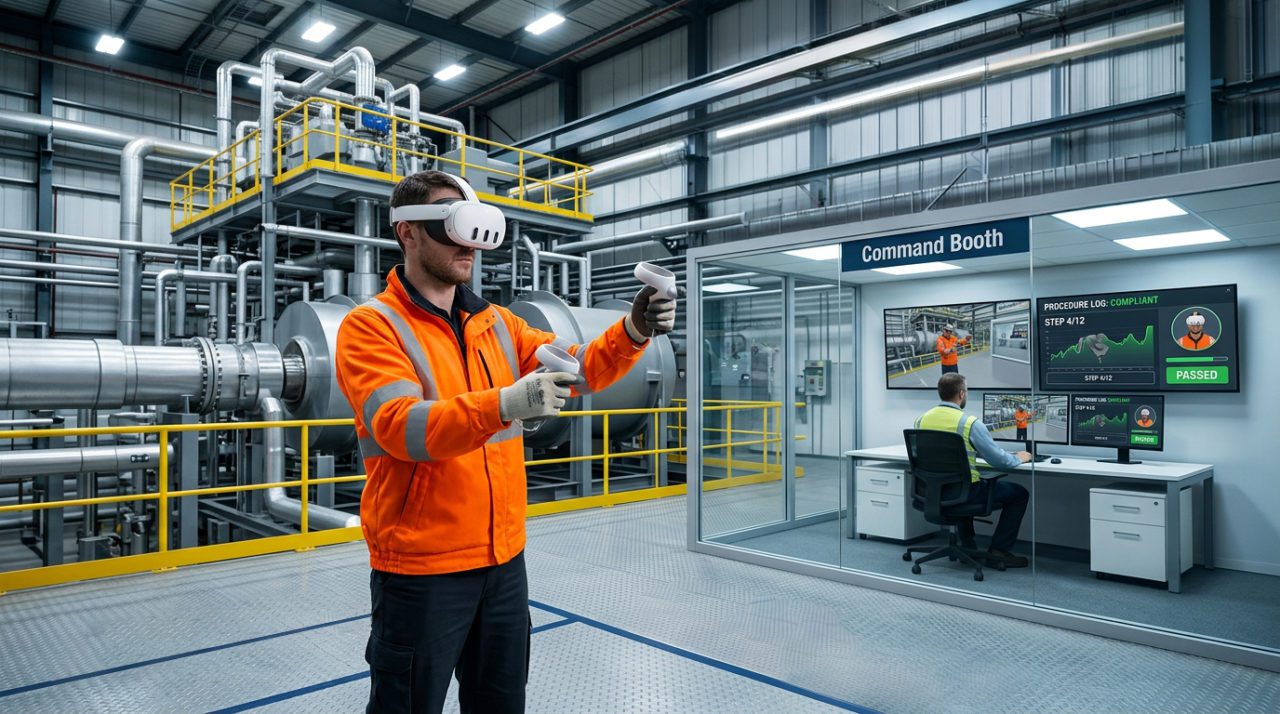
The New Standard of Audit Readiness: Why VR & XR are the Future of European Regulatory Compliance
In the contemporary European regulatory landscape, the definition of “compliance” has undergone a fundamental shift. As of 2026, the era of checking a box for “training completed” has ended. Regulatory bodies ranging from national health and safety executives like Germany’s DGUV (“Deutsche Gesetzliche Unfallversicherung”) to the European Agency for Safety and Health at Work (EU-OSHA) now demand forensic evidence of applied competence.
For enterprises in high-consequence sectors, the gap between knowing a regulation and executing it under operational pressure is the single greatest point of audit failure. Immersive VR and XR technology has emerged not merely as a learning tool, but as critical infrastructure for Data-Driven Risk Management.
Key Takeaways
- Performance-based compliance: European regulators increasingly require demonstrable procedural execution—not proof of training attendance
- Forensic audit trails: VR and XR platforms generate granular data on sequencing, timing, decision-making, and error remediation—creating defensible, inspection-ready evidence.
- Regulation-to-behavior mapping: Training scenarios can be directly aligned to specific EU directives and national enforcement standards, translating legal requirements into observable actions.
- Stress-validated competence: Cognitive load conditioning ensures employees can execute protocols correctly under operational pressure—not just in theory.
- Muscle-memory encoding: Proprioceptive interaction embeds safety-critical procedures into motor memory, reducing failure risk in high-stakes environments.
- Zero-downtime rehearsal: Complex, high-value assets and hazardous environments can be trained on repeatedly without operational disruption or equipment risk.
- Knowledge continuity infrastructure: Institutional expertise from retiring specialists can be digitized into standardized immersive modules, preventing compliance gaps.
- Risk-to-resilience economics: Data-driven proof of workforce competence reduces audit exposure, strengthens insurer positioning, and lowers the cost of non-compliance.
The Regulatory Pressure Cooker: Why 2026 is Different
The European Union has historically set the global gold standard for safety and data privacy. However, recent frameworks have increased the burden of proof on the employer.
EU Framework Directive 89/391/EEC: Modern interpretations now emphasize the “effectiveness” of preventative measures. Auditors are increasingly skeptical of classroom-based training for physical, high-risk tasks.
The EU AI Act (2024/1689): For companies integrating adaptive or AI-driven training systems, the Act mandates strict transparency and data quality standards for “high-risk” vocational tools.
National Safety Enforcement: Agencies like Germany’s DGUV or France’s Assurance Maladie (Ameli) are shifting focus toward “practical proof of instruction,” particularly in hazardous industries where muscle memory is as important as theoretical knowledge.
Mechanisms of Accident Reduction in Immersive VR & XR Training
Immersive VR and XR training reduces workplace accidents where traditional methods often fail. Its effectiveness comes from how the brain learns under stress, combining muscle memory, cognitive load management, and impact visualization.
Below is a summary of how VR & XR training supports safer operations and regulatory compliance in European workplaces:
| Feature | How It Works | Compliance/Relevance | Benefit to European Organizations |
| Proprioceptive Learning | Employees physically perform tasks in VR and XR, encoding them as muscle memory | Supports procedural compliance under EU safety directives | Reduces errors in high-stress scenarios |
| Cognitive Load Conditioning | Simulations gradually increase complexity (alarms, smoke, failures | Aligns with EU health & safety risk management | Trains employees to execute protocols under pressure |
| Error-Consequence Visualization | Workers see consequences of mistakes without real harm | Meets EU risk assessment requirements | Creates strong psychological deterrence against unsafe behavior |
| Real-Time Tracking & Reporting | Actions, errors, and completions are logged automatically | Provides an auditable training record for regulators | Demonstrates measurable training outcomes |
| Continuous Refreshers | VR and XR modules can be repeated easily | Satisfies ongoing training obligations | Keeps workforce consistently compliant and prepared |
Sector-Specific Compliance Mapping: Physical Operational Risk
Immersive VR and XR solutions bridge the “competency gap” by providing a controlled environment where variables can be manipulated to test an employee’s limits.
| Industry | Primary Regulatory Drivers | High-Stakes Training Use Case | Audit-Ready Competency Metric |
| Manufacturing & Heavy Industry | Machinery Directive 2006/42/EC | High-risk Lockout/Tagout (LOTO) and machine interventions | 100% procedural step-validation; zero-error “safe failure” logs. |
| Construction | Temporary or Mobile Construction Sites Directive 92/57/EEC | Spatial hazard identification and high-altitude safety coordination. | Gaze-tracking data proving hazard detection within <2 seconds. |
| Logistics & Warehousing | ADR (Dangerous Goods) / ISO 45001 | Dangerous goods handling and automated forklift interaction | Verification of physical movement accuracy in high-traffic zones. |
| Energy & Utilities | EU Energy Directives / NIS2 | High-voltage grid maintenance and substation emergency response | Stress-load response times; procedural fidelity under “alarm fatigue.” |
| Oil & Gas / Process Industry | ATEX / SEVESO III | Explosive atmosphere protocols and critical valve-sequencing. | Successful remediation of “cascading failures” in a digital twin. |
| Rail & Transportation | Railway Safety Directive (EU) 2016/798 | Trackside safety protocols and rolling stock maintenance | Standardized cross-border safety certification across EU rail networks. |
| Healthcare & Emergency Services | EU MDR (Medical Device Regulation) / Patient Safety | Biohazard containment and high-precision medical SOPs. | Forensic tracking of hand-sanitization and sterile-pathway compliance |
The Forensic Evidence: The Digital Audit Trail
Traditional compliance logs—like spreadsheets or LMS reports—only show who attended training. To satisfy 2026 European audits, organizations must prove what employees actually did and how they performed. Immersive VR and XR platforms act as a “black box” for training, capturing previously invisible data and making audits straightforward.
| Metric | What It Tracks | Compliance Relevance | Benefit |
| Procedural Fidelity | Completion of each step in a safety protocol | Meets EU Machinery Directive procedural requirements | Ensures employees follow protocols exactly |
| Response Latency | Reaction times in emergency scenarios | Aligns with national safety regulations | Confirms employees can respond within legally mandated windows |
| Behavioral Verification | Eye-tracking & spatial analysis of task engagement | Supports EU audit standards | Demonstrates that safety-critical cues were actively recognized |
Bridging the Generational Skill Gap and Knowledge Continuity
Europe’s workforce is undergoing a major demographic shift: veteran engineers and operators are retiring, taking decades of institutional safety knowledge with them. This creates a compliance and safety risk, as gaps in expertise can lead to accidents, procedural errors, or audit failures.
Immersive VR and XR training solves this by preserving expertise and transferring it to new employees in a measurable, audit-ready way:
| Mechanism | How It Works | Compliance & Safety Impact | Benefit |
| Legacy Knowledge Capture | VR and XR modules digitize the tacit knowledge of senior operators | Ensures procedures are preserved for audits and regulatory review | Protects institutional expertise and reduces risk from retirements |
| Rapid Upskilling | New hires train in realistic, immersive simulations | Meets EU competency requirements quickly | Employees reach safe performance levels up to 4x faster, preventing spikes in safety incidents |
| Knowledge Continuity | Training is repeatable and standardized across sites | Provides consistent, auditable training evidence | Maintains operational excellence and long-term regulatory compliance |
Why it matters: By combining legacy capture with immersive, repeatable training, organizations future-proof safety standards and ensure that critical knowledge continues to flow—protecting both people and compliance metrics.
Maximizing ROI Through Immersive VR & XR Compliance Training
For executives, the ROI of immersive VR and XR compliance training is more than avoiding fines—it’s about reducing operational risk, protecting assets, and proving workforce competence. In European audits, the ability to demonstrate measured, safe performance under real-world conditions is increasingly valuable.
| Mechanism | How It Works | Compliance & Safety Impact | Benefit |
| Zero-Downtime Rehearsal | Employees practice on live equipment virtually, without halting operations | Maintains continuous compliance training without interrupting production | Avoids costly downtime and ensures procedural mastery |
| Safe Failure Simulations | Operators experience mistakes in VR and XR without real-world consequences | Provides auditable proof of response under stress | Reduces risk of accidents and regulatory violations |
| Insurance & Risk Optimization | Immersive training data demonstrates workforce competence | Recognized by EU insurers as proactive risk mitigation | Potentially lower premiums and better coverage for high-risk operations |
By enabling safe failure in realistic simulations, companies can train employees to the highest safety standards, capture measurable compliance evidence, and quantify ROI—bridging the gap between workforce readiness, regulatory adherence, and corporate risk management
Conclusion: Turning Compliance into Competitive Advantage
In 2026, leading European organizations no longer treat compliance as a checkbox—they treat it as actionable, auditable, and measurable behavior. Immersive VR and XR training make this possible:
- Audit-ready evidence: Every procedure, reaction, and decision can be tracked, verified, and reported.
- Safer, more skilled workforce: Employees gain hands-on experience, preserve institutional knowledge, and respond confidently under stress.
- Economic and operational value: Companies reduce accidents, protect assets, and demonstrate risk management to regulators and insurers alike.
By integrating immersive training into regulatory strategy, European enterprises can turn compliance obligations into a strategic advantage, building resilience, reducing risk, and proving competence when it matters most. Talk to an expert now