
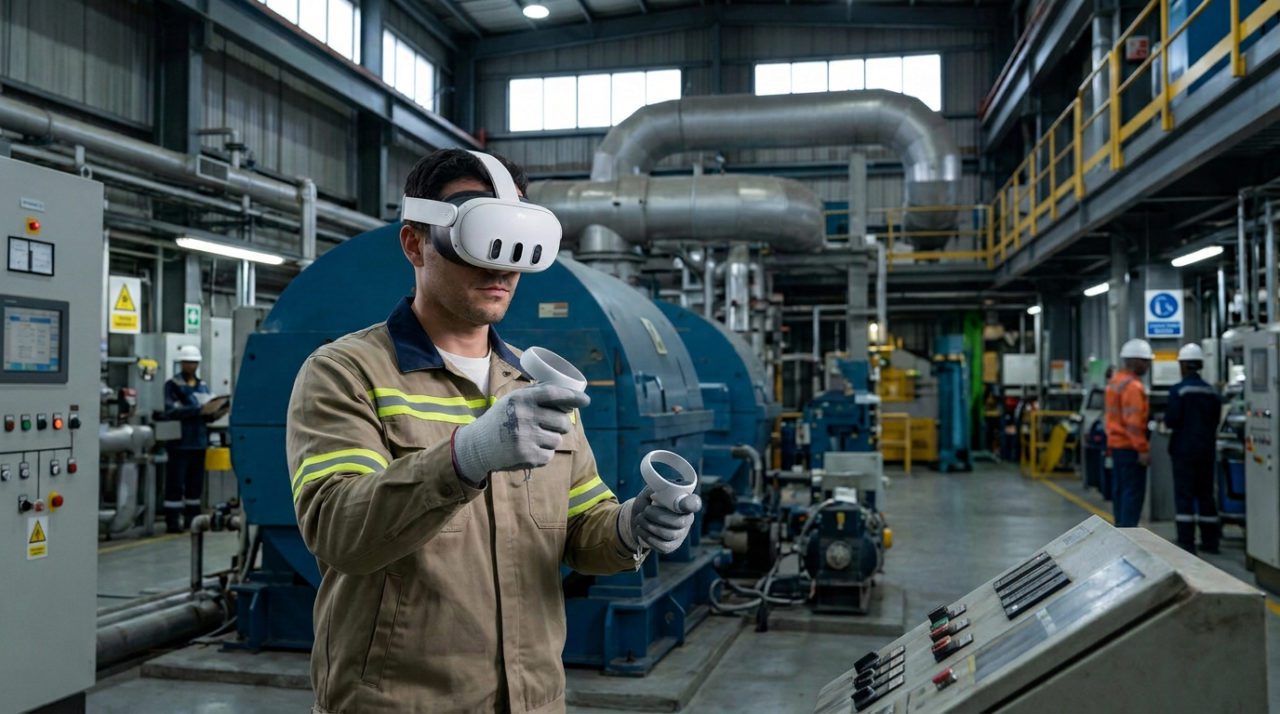
AI-Driven VR & XR Training: Personalized Learning for Workforce Excellence
Traditional workforce training often struggles with engagement, retention, and measurable results. In classroom or e-learning formats, one-size-fits-all approaches fail to account for individual learning styles, prior experience, and cognitive capacity. Enter AI-driven VR and XR training: immersive, interactive experiences that adapt in real time to each learner, offering a personalized path to mastery.
By combining the realism of VR and XR simulations with the intelligence of AI, organizations can improve skill acquisition, reduce errors, and increase overall workforce performance. From manufacturing floors to healthcare simulations, this next-generation training method is redefining how employees learn and perform.
Key Takeaways
- Adaptive learning: AI algorithms adjust training in real time to each learner’s speed, accuracy, and engagement.
- Immersive engagement: VR & XR simulations engage muscle memory, spatial awareness, and cognitive skills for deeper skill mastery.
- Data-driven insights: Performance metrics like procedural fidelity, reaction time, and error recovery provide actionable insights.
- Rapid onboarding: New employees achieve proficiency faster through personalized, repeatable simulations.
- Knowledge preservation: Institutional expertise from senior staff can be embedded in VR/XR modules for consistent training.
- ROI & performance: Reduced errors, faster skill acquisition, and measurable workforce improvements create a strong business case.
- Industry applicability: AI-driven VR/XR training is effective across manufacturing, construction, logistics, energy, oil & gas, rail, and healthcare.
- Safe failure simulation: Learners experience mistakes virtually, building competence and resilience without real-world risk., strengthens insurer positioning, and lowers the cost of non-compliance.
Adaptive Learning: AI Personalizes Every Experience
At the core of AI-driven immersive training is adaptive learning. AI algorithms monitor learner performance in real time, adjusting scenarios, pacing, and feedback to meet individual needs. This ensures employees progress at an optimal speed, avoiding the boredom of tasks that are too easy or the frustration of scenarios that are too difficult.
Key AI Adaptation Metrics:
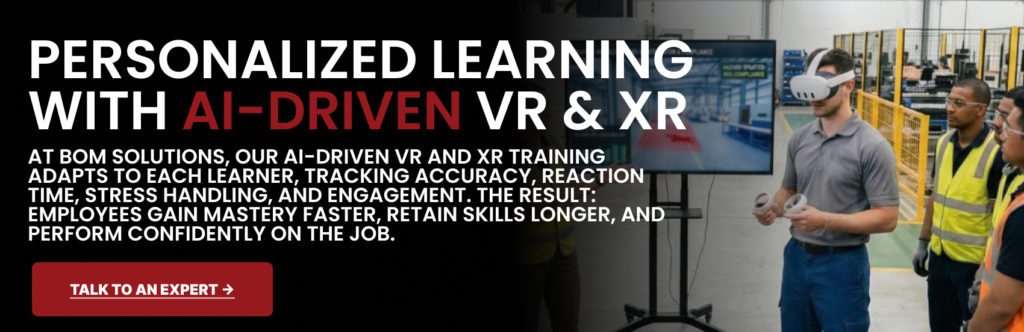
With adaptive learning, employees receive continuous, personalized feedback, enabling them to correct mistakes and master skills more effectively than traditional training methods.
Immersion Boosts Engagement & Skill Mastery
Immersion is the defining advantage of VR and XR training. By placing learners in realistic, interactive scenarios, these platforms engage muscle memory, spatial reasoning, and cognitive processing simultaneously. Employees don’t just memorize procedures—they practice them until mastery becomes instinctive.
For example, a manufacturing operator can virtually perform complex machinery setups under varying conditions, while a healthcare professional can practice emergency procedures without risking patient safety. The combination of AI personalization and immersive environments ensures each learner receives the level of challenge they need to stay engaged and improve.
Data-Driven Insights & Continuous Improvement
One of the most powerful aspects of AI-driven VR and XR training is the data it generates. Every interaction is logged: completion times, procedural accuracy, decision-making under stress, and response patterns. This data allows organizations to:
- Provide personalized feedback for each learner.
- Identify knowledge gaps and areas requiring retraining.
- Benchmark performance across teams or departments.
- Demonstrate training effectiveness with measurable results
Key Training Metrics:
| Metric | Measurement | Benefit |
| Procedural fidelity | Steps executed correctly | Confirms mastery |
| Time to completion | Speed of task performance | Measures efficiency |
| Error recovery | How quickly mistakes are corrected | Builds resilience |
| Scenario completion | Mastery across multiple simulations | Ensures competence |
By turning every training session into a source of actionable insight, organizations can continuously optimize learning outcomes and improve workforce performance.
Bridging Knowledge Gaps & Rapid Onboarding
AI-driven immersive training is particularly effective for rapid onboarding and knowledge transfer. In industries with high staff turnover or complex operations, traditional training often leaves new employees underprepared. AI + VR and XR ensures:
- Institutional knowledge is preserved: Senior employees’ expertise can be embedded into simulations for repeatable, scalable learning.
- Competency is reached faster: Learners achieve proficiency up to 4x faster than with manuals or classroom lectures.
- Consistency across teams: Every employee trains under the same high-fidelity scenarios, ensuring standardization.
This approach minimizes skill gaps, reduces errors, and creates a workforce that is ready to perform confidently from day one.
| Training Method | Time to Proficiency | Engagement | Error Reduction | Cost Efficiency |
| Traditional | Standard | Low | Moderate | Baseline |
| AI + VR and XR | Accelerated | Moderate | High | Optimized |
Key ROI Drivers:
- Reduced operational errors: Employees are better prepared for real-world scenarios.
- Faster skill acquisition: New hires become productive more quickly.
- Cost savings: Less downtime, fewer accidents, and lower retraining costs.
- Scalable, repeatable training: One simulation can be used repeatedly for multiple learners, across locations, without additional costs.
Organizations that implement AI-driven VR and XR training not only improve workforce performance but also maximize operational efficiency and reduce risk exposure.
AI-Driven VR & XR Training Across Industries
AI-driven VR and XR training isn’t one-size-fits-all—it adapts to the unique challenges of each industry. From operational safety to rapid skill acquisition, immersive training delivers measurable benefits across sectors.
| Industry | Training Focus | Key Benefits | Example Use Cases |
| Manufacturing & Heavy Industry | Complex machinery operation, safety protocols | Reduced errors, faster upskilling, improved procedural compliance | Assembly lines, CNC operation, robotics |
| Construction | Hazard recognition, site safety, equipment handling | Accident reduction, compliance tracking, immersive hazard simulation | Crane operation, scaffold safety, site walkthroughs |
| Logistics & Warehousing | Inventory management, equipment operation | Optimized workflow, reduced accidents, faster onboarding | Forklift operation, order picking, warehouse layout training |
| Energy & Utilities | Operational procedures, emergency response | Minimized downtime, safer handling of high-risk operations | Power plant simulations, electrical safety, grid maintenance |
| Oil & Gas / Process Industry | Hazardous materials, procedural adherence | Risk mitigation, regulatory compliance, reduced incidents | Refinery operations, chemical handling, process monitoring |
| Rail & Transportation | Safety protocols, emergency response | Incident prevention, operational continuity, measurable performance | Train operations, signaling, platform safety drills |
| Healthcare & Emergency Services | Patient care, emergency response, procedural accuracy | Faster competency, reduced errors, higher confidence | Surgery simulations, CPR, disaster response drills |
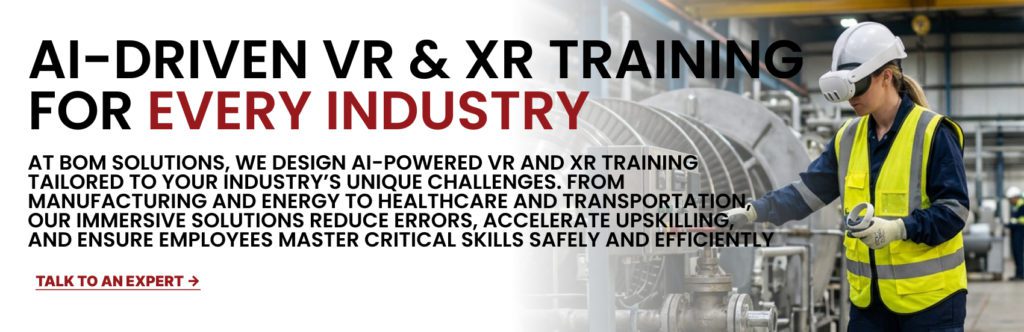
Across every sector, AI-driven immersive training provides personalized, measurable learning experiences, reducing risk, improving workforce performance, and ensuring employees master critical skills in a safe, controlled environment.
Conclusion: Transforming Workforce Performance
AI-driven VR and XR training is more than a learning tool—it’s a performance accelerator. By adapting to each learner, these platforms increase engagement, skill mastery, and measurable workforce performance. Organizations that embrace this technology are able to:
- Upskill employees faster and more effectively.
- Capture and preserve critical knowledge.
- Continuously optimize performance through actionable data.
- Future-proof workforce capabilities in an ever-changing environment
In a competitive global landscape, AI-driven immersive training provides a scalable, measurable, and impactful solution that turns workforce development into a strategic advantage. Companies investing in this approach are not just training employees—they are building smarter, safer, and more capable teams ready for the challenges of today and tomorrow. Talk to an expert now