
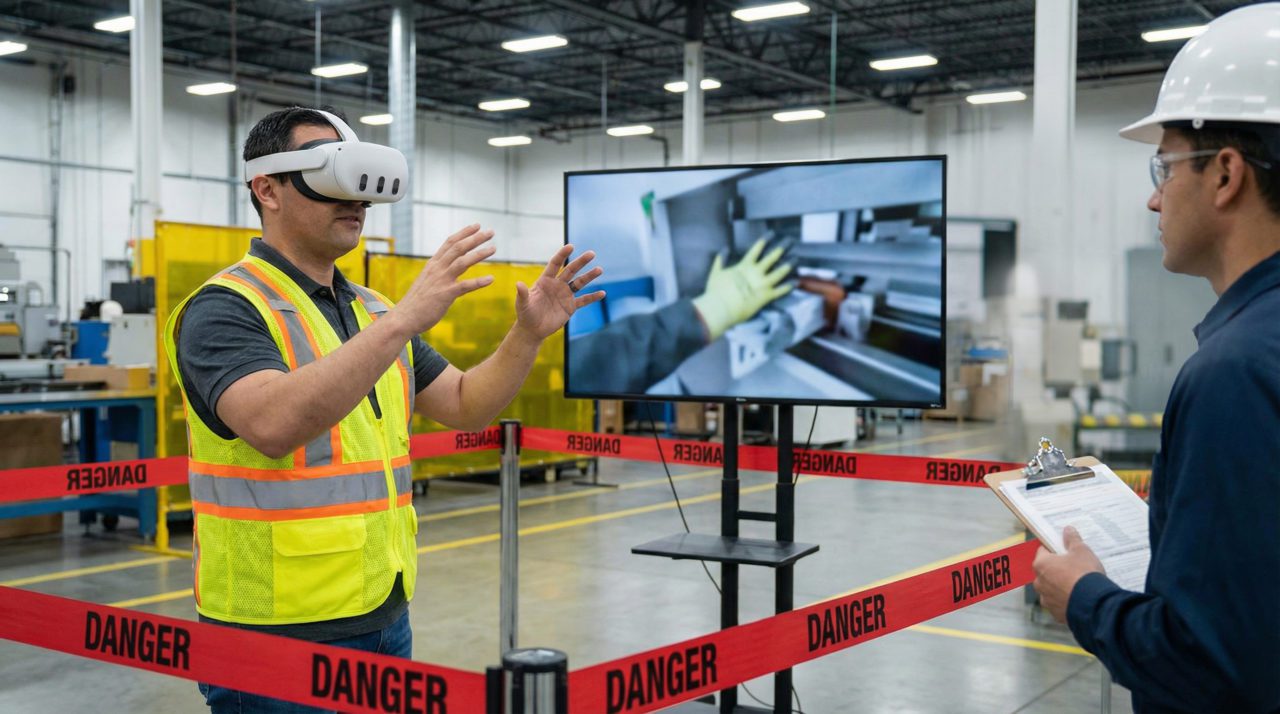
How VR & XR Cuts Workplace Accidents in Europe
Throughout Europe, workplace safety is governed by rigorous regulatory frameworks such as the EU Framework Directive 89/391/EEC, along with national laws like Germany’s ArbSchG (“Arbeitsschutzgesetz”), the UK’s Health and Safety at Work Act, and others. These regulations require employers to assess risks, provide adequate training, and implement preventive measures—not just check a box.
Yet traditional safety training—classroom sessions, handbooks, tick-box e-learning—often fails to prepare employees for the situational complexity, rapid decision cycles, and contextual risk that characterizes modern industrial work.
Immersive VR and XR training represents a paradigm shift: it operationalizes safety knowledge into lived experience, accelerates skill acquisition, and embeds hazard recognition deeply into muscle memory and cognitive judgment.
This article explores how VR and XR training tangibly reduce workplace accidents, how they support regulatory compliance, and why industry leaders—particularly in Europe’s high-risk sectors—are investing strategically in immersive learning solutions.
Key Takeaways
- Compliance: VR and XR training helps meet EU and national safety regulations while generating audit-ready evidence.
- Hazard recognition: Employees learn to identify and react to risks in realistic, high-pressure scenarios.
- Procedural fluency: Repeated practice under simulated stress embeds correct safety procedures.
- Consistent training: Standardized content ensures the same quality and outcomes across teams and sites.
- Data-driven insights: Performance metrics track competency, identify gaps, and support continuous improvement.
- Accident reduction: Immersive simulations reduce near-misses, errors, and workplace incidents.
- High-risk Industry impact: Especially effective in manufacturing, construction, energy, logistics, and healthcare.
- ROI & operational value: Fewer accidents, lower insurance claims, reduced downtime, and stronger workforce readiness.
Workplace Accidents: A Persistent and Costly Challenge
Accident rates remain high in sectors such as manufacturing, construction, logistics, utilities, and healthcare. According to the European Agency for Safety and Health at Work (EU-OSHA):
- Over 3.6 million non-fatal workplace accidents are reported in the EU each year.
- Many of these accidents stem from human error, inadequate hazard perception, and improper response to dynamic conditions.
- The costs of workplace injuries ripple through operations: lost production time, workers’ compensation, regulatory penalties, insurance implications, legal exposure, and reputational harm.
Immersive training doesn’t replace safety management systems, it strengthens them. By moving employees from passive learning to active simulation, VR and XR allow workers to rehearse real tasks, encounter realistic hazards, and develop robust mental models of risk all in a controlled, consequence-free environment.
Mechanisms of Accident Reduction in Immersive VR & XR Training
1. Cognitive Hazard Recognition
Human factors research shows that experiential learning significantly outperforms passive methods in building hazard recognition skills. VR and XR training:
- Presents hazards in contextually rich environments
- Forces learners to detect, interpret, and respond to cues
- Strengthens situational awareness through repetition
This aligns with neurocognitive models of perception-action coupling: by training perception in context, you improve real-world decision accuracy.
2. Procedural Fluency Under Pressure
One of the biggest gaps in traditional safety training is its inability to recreate stress, timing pressure, and uncertainty. VR and XR closes that gap:
- Trainees experience time-critical decision nodes
- They are conditioned to follow protocols under simulated pressure
- Errors become learning events instead of real consequences
This leads to improved response accuracy and faster reaction times during hazardous events in real settings.
3. Standardized Global Deployment
In multinational operations, disparate training quality and language barriers can create safety risks. Immersive training:
- Delivers identical scenarios to all learners
- Supports multi-language instruction and localized content
- Ensures consistent messaging across sites
This mitigates the “instructor variance effect” often seen in classroom safety training and enhances quality assurance across global operations.
The Regulatory Connection: Compliance Meets Performance
Under regulations such as the EU Framework Directive on Safety and Health at Work, employers are required to:
- Evaluate all risks affecting workers
- Provide adequate training and instruction
- Ensure training is adapted to risk levels and work environments
Notably, effective training is not defined by format—it is defined by outcomes. Courts and regulators increasingly recognize that outcome-oriented, evidence-based training is superior to generic compliance checklists.
Immersive training delivers measurable outcomes:
- Learners demonstrate competency in simulated assessments
- Systems capture performance data, enabling proof of training efficacy
- Organizations can generate audit-ready reports linking training to risk reduction
This directly supports defense of compliance and due diligence in regulatory reviews or liability inquiries.
Industry-Focused Impact in Europe
| Industry | Primary Risk Exposure | How VR & XR Reduces Accidents | Regulatory Alignment (EU Context) |
| Manufacturing & Heavy Industry | Machinery entanglement, energy isolation errors, confined spaces | Realistic equipment simulations, lockout/tagout rehearsal, hazard recognition drills | Machinery Directive 2006/42/EC, Framework Directive 89/391/EEC |
| Construction | Falls from height, struck-by incidents, heavy equipment collisions | Site-specific hazard simulations, fall protection practice, dynamic site navigation training | Temporary or Mobile Construction Sites Directive 92/57/EEC |
| Logistics & Warehousing | Forklift collisions, loading dock incidents, traffic flow risks | Spatial awareness training, forklift simulation, workflow hazard mapping | Workplace Directive 89/654/EEC |
| Energy & Utilities | High-voltage exposure, confined spaces, emergency shutdowns | Rare-event simulation, emergency response rehearsal, procedural sequencing under pressure | EU Electricity Directive, national energy safety regulations |
| Oil & Gas / Process Industry | Explosion risk, chemical exposure, shutdown failures | Process simulation, escalation scenario training, incident command drills | Seveso III Directive (2012/18/EU) |
| Rail & Transportation | Operational misjudgment, maintenance errors, signaling risks | Operational simulation, maintenance procedure rehearsal, crisis response drills | Railway Safety Directive (EU) 2016/798 |
| Healthcare & Emergency Services | Biohazard exposure, emergency response coordination, human error under stress | Crisis scenario simulation, infection control training, team coordination drills | EU Occupational Safety Directives, national health safety regulations |
Why This Matters for European Organizations
European regulators increasingly expect employers to go beyond generic safety briefings. Under EU law, training must be:
- Appropriate to the risks involved
- Repeated and updated where necessary
- Adapted to technological and organizational changes
- Demonstrably effective
This is where immersive training becomes strategically important.
VR and XR platforms do not merely deliver content; they generate performance evidence. Organizations can demonstrate:
- That employees were exposed to realistic risk scenarios
- That procedural knowledge was tested
- That performance improved over time
- That corrective training was deployed where needed
In high-risk industries, particularly those subject to audits, insurance review, or cross-border regulatory oversight, this data-backed training model strengthens both operational safety and legal defensibility.
For European enterprises operating in complex industrial environments, immersive training is not just about innovation. It is about building a workforce that is measurably prepared for risk—and being able to prove it.
Measuring Safety Outcomes and ROI
Immersive VR and XR safety training doesn’t just feel effective it generates tangible, auditable results that demonstrate both workforce competence and organizational risk mitigation.
Modern VR and XR platforms capture detailed performance data in real time, including:
- Hazard detection accuracy: Did the trainee identify all relevant risks?
- Response speed and procedural fidelity: Did employees follow correct protocols under simulated stress?
- Error patterns and remediation effectiveness: Which actions require additional training?
- Scenario completion consistency: Are all learners achieving competency benchmarks?
This data allows safety leaders to quantify improvements, link them to reduced incident rates, and prove regulatory compliance. In European contexts, this is especially critical: under the EU Framework Directive 89/391/EEC, organizations must show that training is both appropriate and effective for the risks present.
Beyond compliance, performance tracking enables organizations to calculate ROI: fewer accidents, reduced downtime, lower insurance claims, and improved operational reliability. By transforming training into a data-driven risk management system, VR and XR programs provide executives with actionable insights—not just completed checklists. at scale: number of devices, software distribution, IT support, and device lifecycle management.
Companies using immersive safety training can demonstrate measurable reductions in near-miss incidents, faster emergency response times, and improved procedural adherence – providing clear evidence for regulators, insurers, and internal audits.
Conclusion: Reducing Accidents Through Immersive Competence
Workplace safety is a performance enterprise, not a paperwork exercise. Traditional training fulfills regulatory checkboxes, but often fails to prepare workers for the real complexity of hazards they face.
Immersive VR and XR training bridges that critical gap by:
- Building situational hazard recognition
- Conditioning procedural fluency under pressure
- Standardizing training outcomes globally
- Providing measurable evidence of competency
For organizations operating under rigorous safety frameworks—especially in Europe’s high-risk sectors—immersive training is not just a cutting-edge tool—it’s a strategic investment in risk mitigation, legal compliance, and operational resilience. Talk to an expert now