
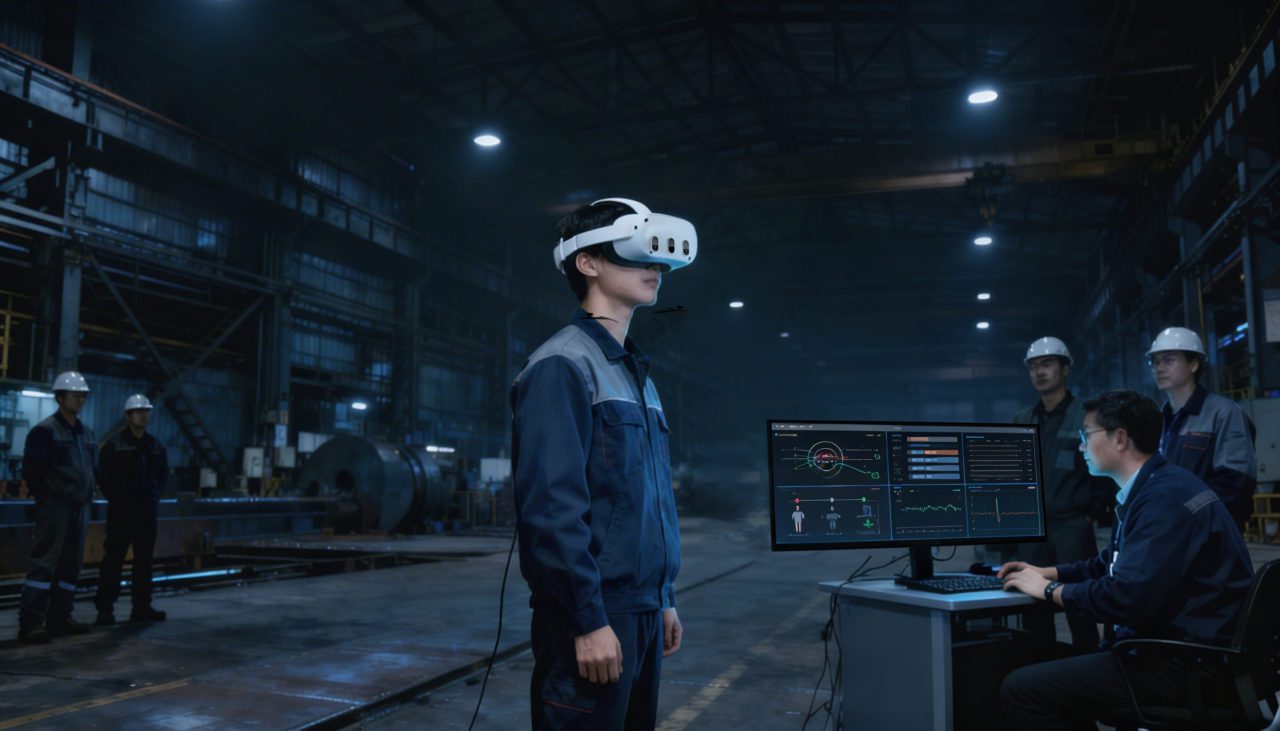
The XR Data Strategy: Transforming Immersive Training into a Predictive Risk Engine
For most enterprises, virtual reality training remains a isolated “learning event,” with success measured by simple completion rates or quiz scores. This is a fundamental strategic failure. The true power of enterprise XR does not lie in the immersion itself, but in the extraordinary volume of high-fidelity, biometric, and procedural data generated every second a user is inside the headset. While your current LMS tracks that an employee trained, a sophisticated XR data strategy tracks how they trained—capturing thousands of data points on gaze, decision latency, and physical execution. At [Agency Name], we help forward-thinking organizations transition from passive visualization to active Human Telemetry, converting immersive experiences into a core source of operational intelligence.
Key Takeaways
- Human Telemetry Defined: XR captures granular data on eye movement, physical reaction times, and procedural fidelity—telemetry that traditional training cannot see.
- From Reactive to Predictive: Analyze error patterns across global teams to forecast exactly where the next operational bottleneck or safety incident is likely to occur.
- Optimizing the Digital Twin: Your factory’s digital twin is incomplete without a corresponding model of workforce capability and human response times.
- The Biometric Layer: Non-invasive biometric data (like heart rate or pupil dilation) offers objective proof of stress-inoculation and operational confidence.
- Enterprise Integration: The true ROI is unlocked only when this data is synthesized with your existing ERP, LMS, and IoT stacks to create a unified view of organizational risk.non-compliance.
The Anatomy of XR Data: Visualizing the “How” of Human Performance
Traditional training data is binary: pass/fail, complete/incomplete. This data provides no insight into the quality of the performance or the user’s cognitive state. Enterprise XR, however, functions as a high-density sensor suite for human behavior, capturing data that was previously impossible to measure at scale.
We categorize this “Human Telemetry” into four distinct streams:
| Data Stream | Specific Metrics Captured | What This Reveals About the Worker |
| Procedural fidelity | Adherence to SOP steps, correct sequence execution, object manipulation accuracy | Competence: Do they actually know the correct workflow, or are they guessing? |
| Response Telemetry | Latency between hazard appearance and action (e.g., hitting the E-stop), decision-making speed. | Readiness: Will they freeze under pressure, or is the correct response a reflex? |
| Visual Gaze & Attention | Hazard perception speed, “check-scan” frequency, duration of focus on critical displays. | Awareness: Are they actively scanning for danger, or are they distracted? |
| Non-Invasive Biometrics | Heart rate variability (HRV), pupil dilation (cognitive load), galvanic skin response. | Confidence: Are they executing the task calmly, or are they overwhelmed by stress? |
The Strategic Shift: Building a Predictive Human Risk Engine
The aggregation and analysis of XR telemetry—not the headset itself—is the true foundation of a mature digital transformation. By applying predictive analytics to this incoming data, organizations can shift from reacting to incidents to preventing them entirely.
Eliminating Bottlenecks Before Production
Predictive data secures your supply chain by identifying “cognitive friction” in new workflows. By analyzing procedural data across global sites, leadership can see exactly where technicians hesitate. If 80% of your workforce struggles with a specific step in a virtual simulation, that step is a guaranteed bottleneck in the real world. This insight allows process engineers to refine the SOP before deployment, preventing millions in downtime.
Preempting the Incident: Modeling Human Error
Every industrial catastrophe is preceded by a pattern of minor, invisible deviations. XR data makes these deviations quantifiable. By correlating VR performance—such as missed visual cues or slow E-stop reaction times—with historical “near-miss” logs, you can build a model that flags high-risk individuals for proactive remediation. You aren’t just training; you are mapping the probability of error.
The Missing Link: Integrating the “Human Twin” with the Digital Factory
Your enterprise likely already has a sophisticated “Digital Twin” of your facility—a static 3D model integrated with real-time IoT sensors from your machinery. This twin can predict a pump failure, but it cannot predict how your operator will respond to that failure.
The culmination of an XR data strategy is the creation of the “Human Twin”: a dynamic, data-backed model of your workforce’s competence and resilience. By merging the data from your XR Human Telemetry with your factory’s IoT data, you gain a complete, multi-dimensional view of your operational risk. Your Digital Twin can now predict that Pump A will fail in 12 hours, and your Human Twin can confirm that Shift Lead B has successfully completed the emergency shutdown drill for that specific failure with a 98% procedural score and controlled stress levels.
Operational Interoperability: Moving XR Data into the Enterprise Stack
A common failure in digital transformation is the creation of “Innovation Silos”—sophisticated tools that do not communicate with the broader enterprise. To extract maximum ROI, XR telemetry must be treated as a standard data feed, equivalent to IoT sensors or financial logs.
True “Audit-Ready” status is achieved through API-driven integration with your core systems:
- LMS/LXP Integration (xAPI/SCORM): Automatically update employee transcripts with high-fidelity performance metrics, moving beyond “Course Complete” to “Mastery Verified.”
- ERP & EHS Management (SAP/Oracle): Trigger automated safety audits or restrict site access based on real-time XR competency scores. If a technician’s “Human Telemetry” shows a decline in procedural accuracy, the system can automatically flag them for a refresher before they are dispatched to a high-risk task.
- Business Intelligence (PowerBI/Tableau): Feed XR data into your corporate dashboards to visualize the correlation between training performance and actual on-site incident rates.
By treating XR as an integrated data layer rather than a standalone training tool, the organization builds a Closed-Loop Safety System. This is the final step in maturing your digital strategy: moving from “watching a simulation” to “automating organizational resilience.”
Conclusion: Data is the Infrastructure of the Immersive Future
Digital transformation is the relentless pursuit of making the unpredictable predictable. If your digital twin strategy, your IoT deployment, and your ERP stack do not account for the specific, measurable competence of your human operators, your entire transformation is incomplete.
Investing in VR and XR is not an investment in novelty. It is a strategic investment in human performance data. By capturing this telemetry today, you are building the essential infrastructure for a predictive, resilient, and audit-ready enterprise of tomorrow. The future of enterprise risk management isn’t just data-driven—it’s human-telemetry-driven. Talk to an expert now
Frequently Asked Questions
Q: How does XR training data integrate with existing LMS or ERP systems?
A: Modern enterprise XR solutions use xAPI (Experience API) or SCORM to communicate with Learning Management Systems (LMS). For deeper digital transformation, data can be pushed via Custom APIs into ERPs like SAP or Oracle. This allows “Mastery Verified” status to trigger real-time operational permissions, ensuring only those with proven virtual competence can access high-risk physical sites.
Q: Is biometric data collection in VR compliant with GDPR and privacy regulations?
A: Yes, provided the strategy prioritizes Data Anonymization and Informed Consent. Professional XR deployments focus on “Performance Telemetry” (reaction times, accuracy) rather than personal identity. At the enterprise level, biometric markers like heart rate variability are typically aggregated to assess the effectiveness of the simulation or the general stress-resilience of a cohort, rather than to monitor an individual’s private health data.
Q: What is the measurable ROI of switching from traditional training to a VR Data Strategy?
A: The ROI is triple-faceted: Time, Risk, and Retention. Organizations typically see a 30-40% reduction in onboarding time. More critically, the “Predictive Risk” element reduces the frequency of “Low-Frequency, High-Consequence” accidents, which can save millions in insurance premiums, legal fees, and operational downtime that traditional “click-through” training cannot prevent.
Q: Can XR data really predict real-world human error?
A: By analyzing “Human Telemetry”—specifically gaze patterns and response latency—AI models can identify “Cognitive Friction” points. If data shows a recurring 3-second hesitation during a virtual emergency shutdown, that hesitation will manifest as a critical failure point under real-world pressure. Mapping these virtual “near-misses” allows for proactive remediation before a physical incident occurs.