
The Immersive DAP: Bridging the Gap Between Software and Physical Execution
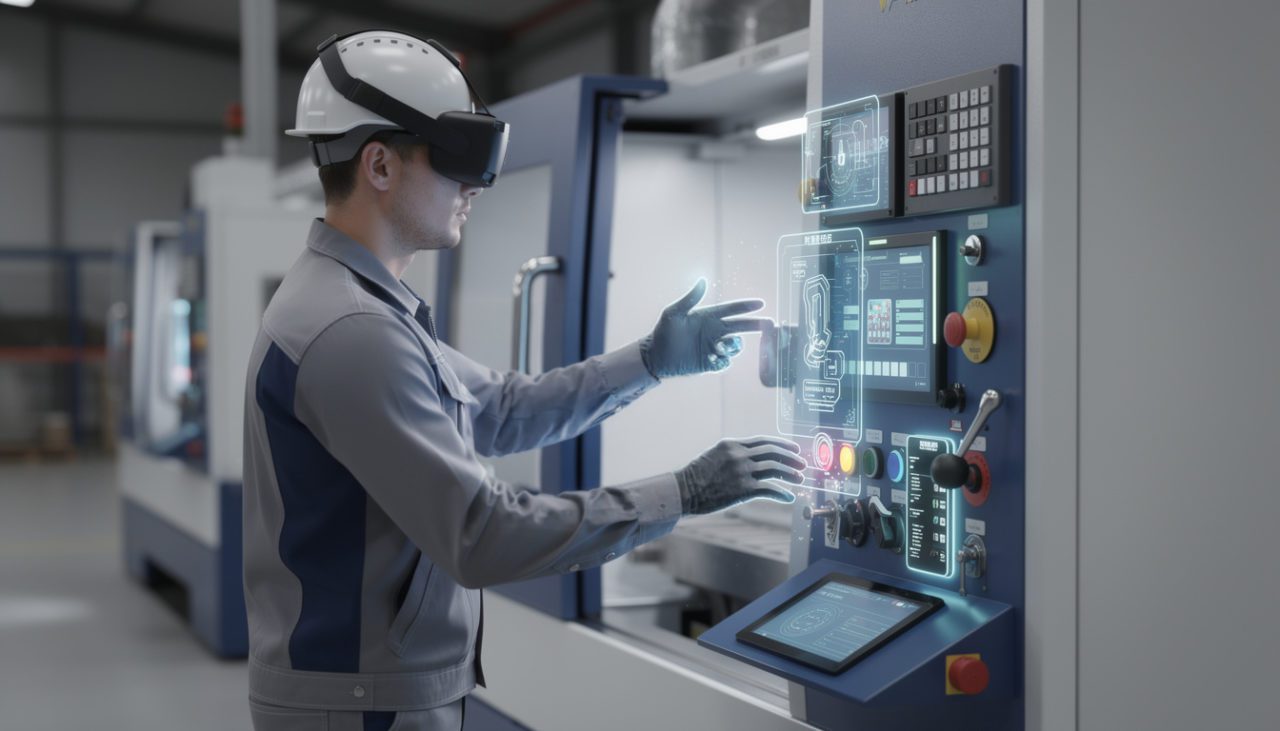
Most Digital Adoption Strategies (DAS) fail because they assume the “user” is sitting at a desk. In the context of a $100M Digital Transformation, organizations invest heavily in Digital Adoption Platforms (DAPs) like WalkMe or Whatfix to guide employees through new software interfaces. However, for the industrial frontline—manufacturing, logistics, and energy—the “interface” isn’t just a screen; it’s a high-stakes interaction between a human, a digital system, and a physical machine. If an operator cannot translate a digital command into a precise physical action under pressure, your digital adoption has failed. At BOM Solutions, we redefine VR and XR as the Physical-Digital Bridge. We provide the immersive infrastructure that ensures your workforce doesn’t just “use” a new digital system, but masters the operational reality it creates.
Key Takeaways
- The Physical-Digital Bridge: VR/XR functions as the missing “spatial” layer of a Digital Adoption Platform, connecting software commands to physical execution.
- Frictionless Interface Onboarding: Immersive simulations allow workers to master complex IoT and AGV interfaces before they ever touch the live equipment.
- Data-Validated Readiness: Digital adoption is no longer a “feeling”; it is a metric tracked through procedural accuracy and interaction latency in the headset.
- Democratizing Tech Literacy: Spatial interfaces in VR make complex digital systems intuitive for legacy workforces, regardless of their prior technical background.
- Risk-Free Sandboxing: XR provides a “safe-fail” environment for employees to experiment with new digital workflows without risking hardware damage or downtime.
- Closed-Loop Adoption: Integrating XR telemetry back into the enterprise stack ensures that digital adoption is verified, not just assumed.
Why Traditional DAPs Fail the Industrial Frontline
Standard Digital Adoption Platforms are designed for SaaS. They work perfectly for onboarding an HR team to Workday, but they fall apart the moment a technician needs to use a new tablet-based interface to calibrate a 5-axis CNC machine.
The problem is Contextual Disconnect. A 2D tooltip on a screen cannot teach the spatial awareness, the haptic pressure, or the peripheral environmental hazards that exist in a high-risk facility. Traditional training asks a worker to look at a digital instruction and “jump” to a physical action. This leap is where errors occur. VR removes the leap; by simulating the digital interface within the virtual representation of the physical machine, the worker practices the unified movement. The software and the hardware become a single, fluid experience.
The Immersive DAP Matrix: Software vs. Spatial Adoption
To understand why immersion is non-negotiable for industrial Digital Transformation, we must compare the capabilities of traditional screen-based adoption tools against an Immersive DAP.
| Feature | Traditional DAP (Screen-Based) | Immersive DAP (VR/XR) | Operational Impact |
| Context | 2D Software UI only | 3D Spatial & Environmental | Reduces “Spatial Confusion” during live tasks |
| Muscle Memory | Point-and-click | Full-body procedural movement | Lowers reaction time in emergency SOPs. |
| Risk Environment | Non-existent | Simulated High-Risk/High-Pressure | Inoculates workers against “Alarm Fatigue.” |
| Data Capture | Click-streams & Heatmaps | Gaze, Latency, & Procedural Fidelity | Provides a “Human Telemetry” risk profile |
| Feedback Loop | In-app tooltips | Real-time Haptic & Visual Guidance | Accelerates “Time-to-Mastery” by 40%. |
Accelerating Digital Literacy Through Spatial Computing
A primary hurdle to digital adoption in heavy industry is the Digital Divide. You have an aging, highly skilled workforce that understands the machinery but may be intimidated by the new “Smart Factory” interfaces.
Intuitive Interaction Design
VR leverages Natural User Interfaces (NUI). Instead of navigating nested menus on a handheld device, a worker in a VR simulation can see a 3D overlay on the machine itself. This spatial context makes the digital system feel like a natural extension of the tool they have used for 20 years. When digital adoption feels like “common sense” rather than “IT training,” the speed of adoption triples.
The “Sandbox” Effect
Fear of breaking expensive equipment is a massive deterrent to digital adoption. When employees are afraid to “click the wrong button” on a new digital controller, they revert to legacy manual processes. XR provides a zero-risk sandbox. By encouraging employees to “break” the digital system in a virtual environment, you build the curiosity and confidence required for true digital fluency.
Operational Interoperability: Integrating the Immersive DAP
To be a true Digital Adoption Platform, the XR solution must talk to the rest of your stack. Digital adoption isn’t “complete” until the data proves the workforce is ready for the live environment.
- IoT-Syncing: Use real-world machine data to trigger specific XR “Refresher” modules. If an IoT sensor detects a recurring operator error on a specific line, the system can automatically assign a targeted VR adoption session to that shift.
- Digital Twin Feedback: Use the data from how workers interact with virtual interfaces to redesign the UI/UX of your actual physical controllers.
- HR-Transformation Mapping: Correlate digital adoption speed with your broader Digital Transformation KPIs to prove the ROI of your immersive strategy to the board.
Conclusion: Stop Guessing, Start Measuring
If your Digital Transformation strategy treats “Software” and “Physical Labor” as two separate workstreams, you are creating a recipe for operational failure. True digital adoption happens at the intersection of the two. By utilizing VR and XR as an Immersive DAP, you ensure that your $100M investment in new technology is actually utilized by the people on the frontlines.
Don’t just give them new tools. Give them the immersive confidence to use them. Talk to an expert now
Frequently Asked Questions
Q: How is VR training different from a standard Digital Adoption Platform (DAP)?
A: A standard DAP (like WalkMe) is a software overlay for 2D screens. An Immersive DAP (VR/XR) is an environment overlay for the 3D world. It doesn’t just show you where to click; it trains the spatial and physical movements required to interact with digital systems in a real-world, high-risk environment.
Q: Can VR help older employees adopt digital technology faster?
A: Absolutely. VR uses “spatial intuition,” which is often more natural for legacy workers than navigating a 2D tablet or computer screen. By placing digital commands in 3D space exactly where they relate to the physical machine, VR removes the “technical” barrier and focuses on the “functional” task.
Q: Does an Immersive DAP integrate with our existing software (SAP, Salesforce, etc.)?
A: Yes. Professional XR solutions use APIs to sync with your existing software stack. This means an employee’s performance in a virtual simulation can be used to unlock permissions in your actual ERP or EHS system, ensuring they only use live digital tools once they’ve proven adoption in VR.
Q: What is the biggest ROI of using XR for digital adoption?
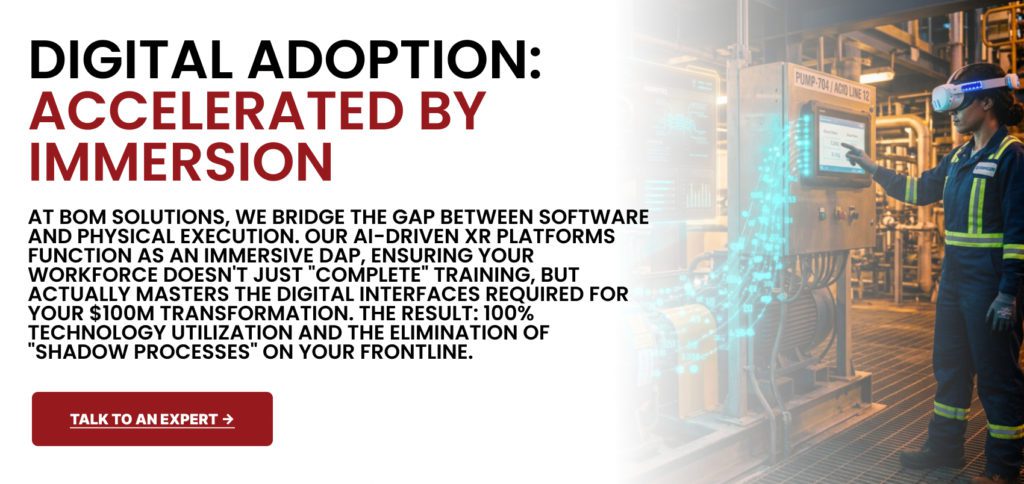
A: The biggest ROI is the elimination of “Shadow Processes.” When digital adoption fails, workers find manual workarounds that bypass your new systems, rendering your DX investment useless. XR ensures workers are comfortable and competent with the new digital workflow, ensuring 100% utilization of your new technology.