
The Psychology of Immersion: Using VR & XR to Scale Change Without the Friction
Digital transformation (DX) is rarely a failure of technology; it is almost always a failure of Change Management. For European enterprises, the “Emotional Cost” of restructuring—the anxiety, the skepticism, and the inertia of a workforce comfortable with legacy systems—is the primary driver of project delays and budget overruns. When a new ERP is deployed or a manufacturing line is automated, the technical shift happens in days, but the human shift can take years. At BOM Solutions, we leverage the power of Immersive Psychological Inoculation. By allowing your workforce to inhabit the “New Normal” in a virtual space before the physical transition occurs, we neutralize the fear of the unknown and convert passive resistance into active competence.
Key Takeaways
- Neutralizing Fear: VR allows employees to “fail safely” in new workflows, removing the anxiety associated with high-stakes digital shifts.
- Cognitive Familiarity: Immersion builds spatial and procedural memory months before physical hardware or software is deployed on-site.
- Reducing Change Fatigue: Gamified, intuitive XR modules replace dense manuals, lowering the “mental tax” of constant corporate restructuring.
- Global Synchronicity: Deploy a single, unified vision of change across multiple languages and time zones simultaneously to prevent “local drift.”
- Empathetic Leadership: Use XR to train managers in the “soft skills” of leading teams through the friction of a digital transition.
Beyond the Manual: Why Immersion Beats Information
In traditional Change Management, organizations rely on Information Density: town halls, PDFs, and slide decks. The psychological flaw here is that information is not experience. A worker can read about a new automated safety protocol, but their brain still perceives the change as an abstract threat to their established routine.
Immersive XR flips this script by providing Experiential Certainty. When an employee puts on a headset, they aren’t learning about the change; they are living it.
- The “Safe Fail” Mechanism: Much of the resistance to change stems from a fear of looking incompetent in front of peers during a transition. VR provides a private, judgment-free environment to master new digital tools.
- Muscle Memory vs. Theoretical Knowledge: By the time the new machinery arrives on the factory floor, the operator’s nervous system already recognizes the movements. The “New” has already become the “Routine.”
Structural Agility: Scaling Change Across the Global Enterprise
One of the greatest hurdles in Change Management is Velocity. In a distributed enterprise, a directive issued at the HQ in Zurich can take months to be correctly interpreted and implemented at a facility in Poland or Brazil. This lag creates “Operational Dissonance,” where different sites are running on different versions of the truth.
Instantaneous Global Alignment
With an XR-driven strategy, Change Management becomes Version Controlled. When a safety protocol or a logistical workflow changes, the update is pushed to every headset in the global fleet simultaneously. There is no “translation error” and no delay. Every employee, regardless of location, experiences the exact same “Gold Standard” of the new operational reality at the same time.
Overcoming “Cultural Inertia”
Legacy workforces often harbor a “this is how we’ve always done it” mentality. VR disrupts this by providing a visualization of the benefits of the change. By simulating the increased efficiency, safety, and ease of the new digital workflow, XR allows the workforce to see the “ROI” for their own daily lives, turning skeptics into advocates for the transformation.
Measuring the “Human Cost” of Change
Change Management is traditionally a “dark” metric—you only know it’s failing when turnover increases or productivity dips. XR changes this by providing Adoption Analytics.
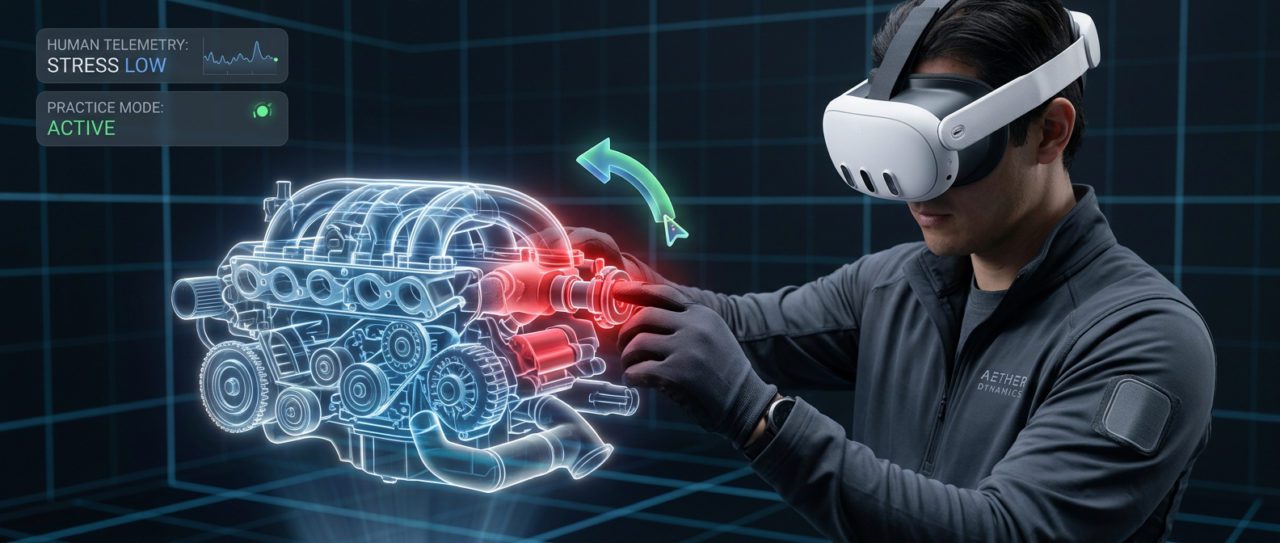
By tracking engagement levels, time-to-mastery, and error rates within the VR environment, leadership can identify exactly which departments or regions are struggling with the transition. If the data shows a high “Cognitive Load” (measured via pupil dilation or heart rate) during a specific phase of the change simulation, management can intervene with targeted support before the physical rollout. This transforms Change Management from a reactive HR function into a proactive, data-driven operational strategy.
Operational Interoperability: Anchoring Change in the Tech Stack
For Change Management to stick, it cannot exist in a vacuum. The data generated during these transition-focused VR sessions must flow into the broader enterprise systems to ensure the change is permanent.
- LMS Synchronization: Automatically tag employees as “Transition Ready” once they hit a specific mastery threshold in the XR environment.
- EHS Risk Mapping: Correlate XR performance with on-site incident reports to see if the “Change Fatigue” is manifesting as a safety risk in specific teams.
- Predictive Scheduling: Use XR telemetry to determine which teams are ready for the “Go-Live” date of a new digital system and which teams require more time, preventing a premature rollout that could crash production.
Conclusion: Immersion is the Lubricant of Digital Transformation
Change is inherently friction-heavy. Every new digital initiative you launch creates a wave of psychological resistance that threatens your ROI. By integrating VR and XR into your Change Management framework, you aren’t just “training” your people; you are engineering out the friction. You are giving your workforce the spatial, procedural, and emotional confidence to move into the future of your enterprise without looking back.
In the race for digital supremacy, the companies that manage change the fastest win. Immersion is your speed. Data is your proof. Talk to an expert now
Frequently Asked Questions
Q: Why is VR more effective for Change Management than traditional workshops?
A: Workshops provide theory; VR provides experience. Change resistance is rooted in the “amygdala hijack”—the brain’s natural fear response to the unknown. VR bypasses this by creating a controlled, safe environment where the “unknown” becomes familiar, allowing muscle memory to replace anxiety before the real-world shift occurs.
Q: Can XR training reduce “Change Fatigue” in a workforce?
A: Yes. Change fatigue happens when employees feel overwhelmed by constant, poorly communicated shifts. VR simplifies the transition by making the “New” intuitive and gamified. It reduces the cognitive load required to learn a new system, making the transition feel like a natural progression rather than an exhausting hurdle.
Q: How do we measure the success of Change Management in a VR environment?
A: We track “Time-to-Competence” and “Procedural Fidelity.” If an employee can execute a new, complex workflow in VR with 100% accuracy and low stress markers (reaction time/latency), they have successfully navigated the “Change Gap.” These analytics provide leadership with a “Green Light” for physical deployment.
Q: Is it difficult to scale XR change management across global locations?
A: Actually, it is easier than traditional methods. Using Mobile Device Management (MDM), a company can push a new virtual training module to thousands of headsets globally in seconds. This ensures a “Single Source of Truth” for the change, eliminating the inconsistencies that occur when local trainers interpret HQ directives differently.